Crescent College Comprehensive incorporates the characteristics of Jesuit Education. It seeks to develop fully each student’s religious, moral, social, intellectual, physical and cultural sensibilities. As an important means of doing this the school strives to create a strong sense of community between parents, students and teachers.
Crescent is very proud to be a catholic Jesuit school educating young men and women in the spirit of Christ and to be in the words of Pedro Arrupe SJ to become ‘Men and Women for and with others’.
Who are the Jesuits?
The Society of Jesus (Jesuits) is a Catholic male religious order, founded by St. Ignatius Loyola and his companions in 1540. We are priests and brothers who live in community and are called to imitate Jesus Christ as poor, chaste and obedient men. They offer their lives to the Lord and he sends us into the world to help with His mission.
The Jesuits first came to Ireland in penal times but we really got going after the arrival of Fr. Peter Kenny SJ in 1811. Since then we have made a significant contribution to the life of the Irish church. Jesuits are known for their role in Catholic education, retreats, social justice and academia. A large number of Irish Jesuits have retired from the main work of their lives and they have handed over much of the day-to-day responsibility of running institutions to lay people.

What is Jesuit Education?
The ultimate aim of Jesuit Education is that full growth of the person which leads to action – action that is suffused with the spirit and presence of Jesus Christ, the Man for Others.
The Charter for the Irish Province known as the Characteristics of Jesuit Education is central to the schools Ethos. The Characteristics are summarised as follows:
Characteristics of Jesuit education
- Finding God in all things
- Caring for the individual – Cura Personalis
- Growing towards Freedom and Responsibility
- Christ is the Model for Human life
- A Faith that Does Justice
- In Service Of The Church
- Striving For Excellence
- Working as a Community
- Adaptable and Open to Growth
In 2019 the Jesuits reviewed where Jesuit Education was and created a document called ‘A Living Tradition’ and they identified Ten Global Identifiers of Jesuit Education, which each Jesuit School all over the world are committed to doing. They are as follows:
To act as a universal body with a universal mission
- Jesuit Schools are committed to being Catholic and to offer in-depth faith formation in dialogue with other religions and worldviews
- Jesuit Schools are committed to creating a Safe and Healthy Environment for all
- Jesuit Schools are committed to Global Citizenship
- Jesuit Schools are committed to the Care of all Creation
- Jesuit Schools are committed to Justice
- Jesuit Schools are committed to being Accessible for All
- Jesuit Schools are committed to Interculturality
- Jesuit Schools are committed to being a Global Network at the service of the Mission
- Jesuit Schools are committed to Human Excellence
- Jesuit Schools are committed to Life-Long learning
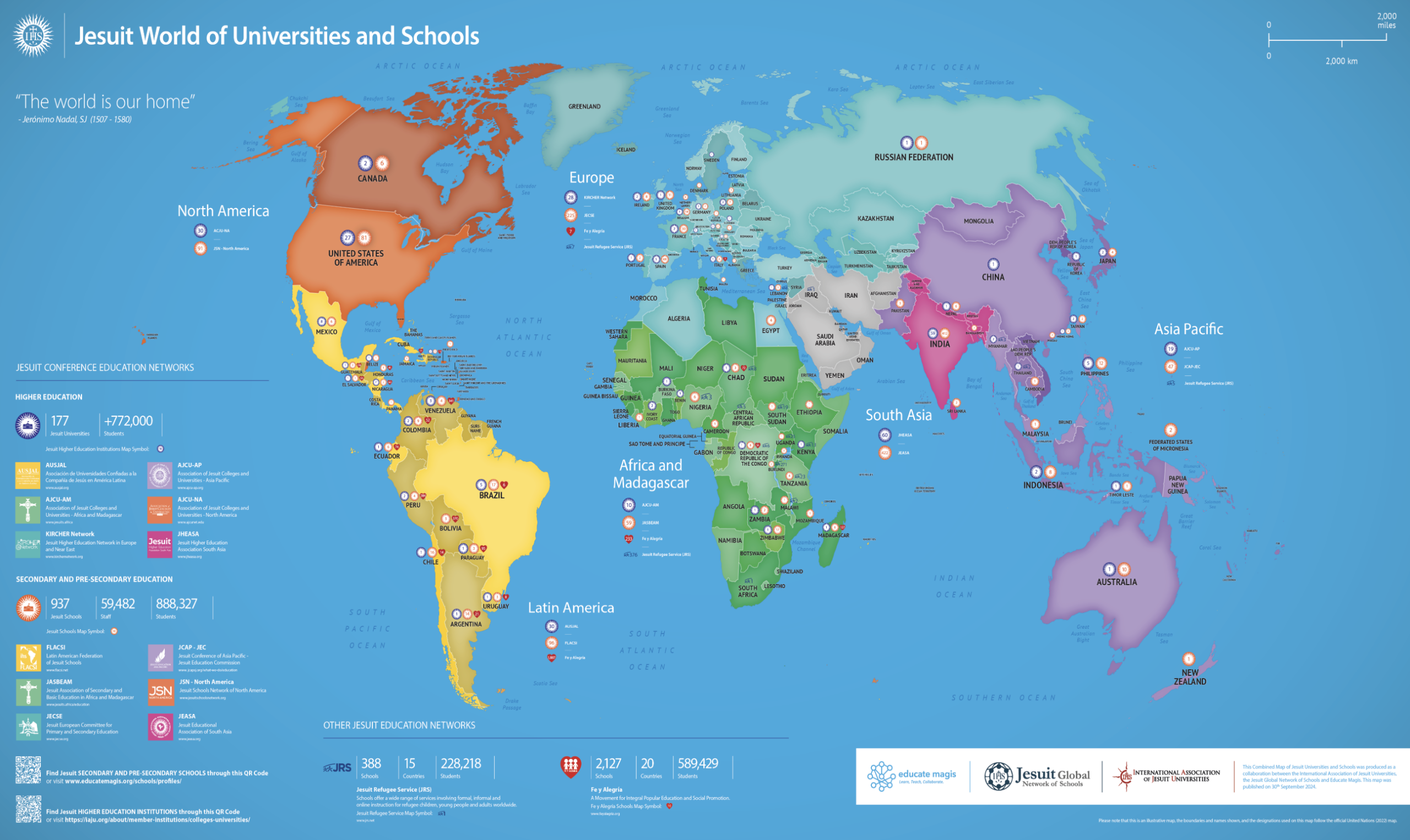
Crescent is part of the Globa Jesuit Education Network. Below is an infographic illustrating the shared mission of St. Ignatius of Loyola in today’s society.

Our international network of schools is uniquely suited to educate global citizens who will be able to participate in a globalisation of solidarity, cooperation and reconciliation that fully respects human life and dignity and all of God’s creation. Our commitment to networking as a universal body and our call to the frontiers, comes from our awareness of the world and our desire to effectively help students face global challenges.
Check out Educate Magis to see Jesuit Education in a Global Context
There are nine schools in the Irish Jesuit Education Trust (Irish Province) and they are as follows:
- Crescent College Comprehensive SJ – Limerick
- Colaiste Iognaid SJ – Galway
- Belvedere College SJ – Dublin
- Gonzaga College SJ – Dublin
- Clongowes Wood College – Kildare
- Mount Carmel Secondary School – Dublin
- St. Declans Special School – Dublin
- Gardiner Street Primary School – Dublin
- Scoil Iognaid – Galway

The Life of St. Ignatius of Loyola

Early Life
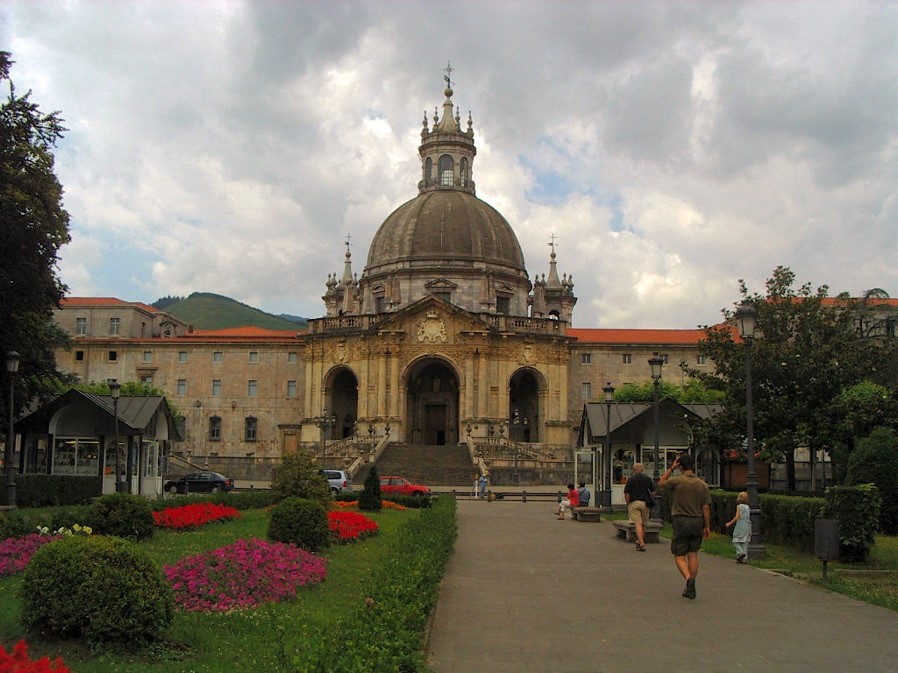
Ignatius of Loyola was born Íñigo López de Oñaz y Loyola in 1491 at Loyola Castle in the Basque region of northern Spain. He was the youngest of thirteen children born into a noble family. As a young man, Ignatius was trained as a courtier and soldier. He dreamed of military glory and fame rather than sainthood.
The Battle of Pamplona and Conversion
In 1521, while defending the city of Pamplona against French forces, Ignatius was struck by a cannonball that shattered his leg. The French soldiers, impressed by his courage, carried him back to Loyola Castle to recover.
During his long recovery, Ignatius endured several painful operations. Unhappy that one leg was left shorter, he insisted that the bone be re-broken and reset. Despite this, he walked with a limp for the rest of his life.
While recovering, Ignatius asked for books of chivalry to pass the time. None were available, so he was given two religious books instead, the life of Christ and the life of Saints. Reading these works deeply affected him. He began to notice that imagining a life of service to Christ and the saints brought him a lasting sense of peace and joy, what he would later call consolation, whereas dreams of military glory left him restless. This was the beginning of his spiritual conversion.
Manresa and the Spiritual Exercises
After leaving Loyola, Ignatius first went to the Benedictine monastery at Montserrat, where he laid down his sword before a statue of Our Lady. He then spent nearly a year in Manresa (1522–1523), living simply, praying intensely and wrestling with deep spiritual struggles.
It was during this time that he began developing what would later become the Spiritual Exercises, a structured guide to prayer and discernment that remains central to Jesuit spirituality today.
Journey to Jerusalem
Ignatius longed to follow Christ as closely as possible. In 1523, he travelled largely on foot and by ship to Jerusalem, hoping to remain there permanently and serve in the Holy Land.
At the time, the Franciscans were the official custodians of the Christian holy places. They welcomed him but ultimately ordered him to return to Europe. They feared for his safety and believed his presence could create political difficulties under Ottoman rule. Ignatius obeyed, recognising that obedience and discernment were essential to his mission.
Education and Studies
Ignatius realised that if he was to help others spiritually, he needed a proper education. Having only a basic military and courtly formation, he returned to study beginning with Latin grammar alongside young schoolboys in Barcelona.
He later studied in Alcalá and Salamanca in Spain. However, because he gathered people for prayer and spiritual conversation without formal theological qualifications, he was questioned by the Inquisition (though never condemned).
Eventually, he travelled to the University of Paris, where he studied philosophy and theology. It was there that he met Peter Faber and Francis Xavier.
Along with several other companions, they formed a close-knit group committed to serving Christ.
Founding of the Society of Jesus
On 15 August 1534, in a chapel on Montmartre in Paris, Ignatius and six companions took vows of poverty and chastity. They planned to travel to Jerusalem, but when war prevented this, they offered themselves to the Pope for service wherever the need was greatest. In 1540, Pope Paul III officially approved their new religious order: the Society of Jesus (Jesuits). Ignatius became the first Superior General and led the order from Rome until his death in 1556.
Jesuits and Education: An Unexpected Mission
Education was not the original aim of the Jesuits. Their first intention was missionary work, preaching, spiritual direction and serving the Church wherever needed. However, requests soon began arriving from cities and rulers across Europe asking the Jesuits to open schools. They saw that forming young people intellectually and spiritually was a powerful way to serve both the Church and society. Almost “by accident,” education became one of the Jesuits’ principal ministries. By the time Ignatius died in 1556, the Jesuits were already operating dozens of schools. Today, Jesuit education has grown into a global network serving approximately 2 million students worldwide across primary schools, secondary schools and universities. Jesuit schools aim not only for academic excellence but for the formation of the whole person intellectually, spiritually, morally and socially often described as forming “men and women for others.”
Iconography
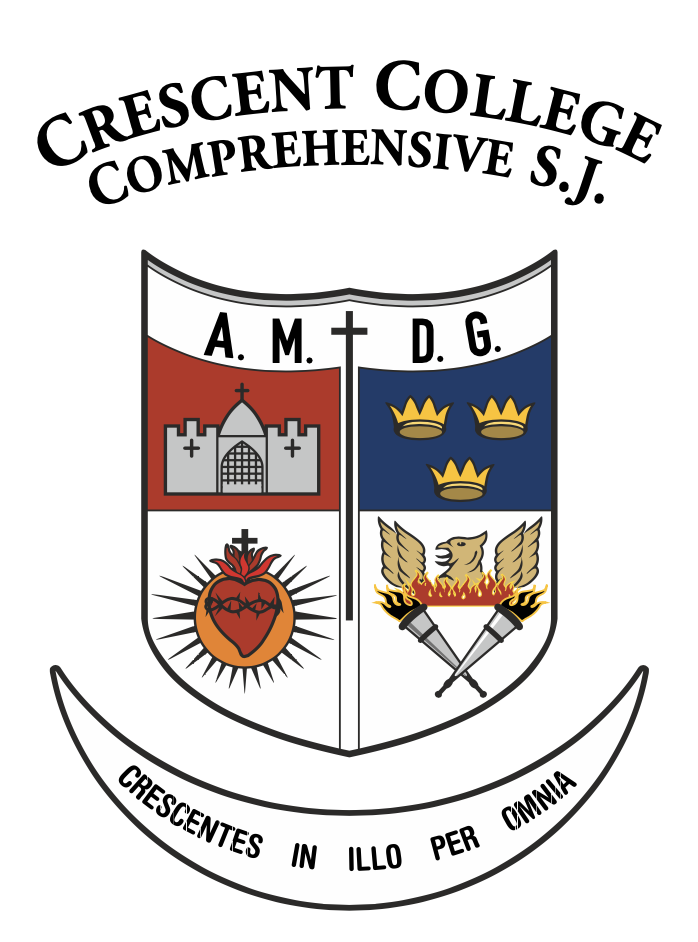
AMDG – The global motto of the Jesuits. Ad Majorium Dei Glorium – For the Greater Glory of God
Cresentes in Illo Per Onmia – Growing in him through all things.
Motto of Crescent College Comprehensive SJ

Profile of a Graduate of a Jesuit School
As a student progresses through a Jesuit school he or she will become part of the tradition, experiencing first hand its pattern of teaching, values and practices, as informed by the Ignatian vision. It is our hope that each student will accept this rich heritage and make it their own and in so doing will be prepared for life, which itself is a preparation for eternal life.
By the end of their time in a Jesuit school it is hoped that a students is becoming progressively:
a) A grateful, honest and forgiving person.
b) Committed to a Christian faith that does justice.
c) Willing to articulate religious faith.
d) Open to growth.
e) Intellectually competent.
f) Socially able.
g) Culturally aware.
h) Physically and emotionally developed.
i) Committed to striving for excellence.
j) Willing and able to exercise leadership.
School Crest
1. On the top panel is the motto AM+DG.
2. In the top left hand box is a castle, the emblem of Limerick city whose motto is ‘ Urbs Antiqua Fuit Studiisque Asperrima Belli” – an ancient city well versed in the arts of war . It is not known exactly when, or by whom, the city motto was chosen. It is a quotation from Virgil’s Aeneid and was quoted during the time of the sieges in the mid 17th century.
3. At the top right hand corner are the three crowns of Munster.
4. At the bottom left hand is the emblem of the Sacred Heart College, the Crescent, the precursor of the school. The emblem shows the heart of Jesus, pierced by a crown of thorns, which has paid the price of love and is unvanquished. It is a sign of God’s love and mercy and recalls the invitation in the Bible, in Ezekiel to change our ‘heart of stone’ into a ‘heart of flesh.’ In the book of Samuel 167 we read:
”God does not see as man sees; man looks at appearances but the Lord looks at the heart.’
5. The bottom right hand corner shows the Eagle from the crest of Mungret College 1882 – 1975. The eagle recalls the passage from the Psalm 103 “Bless the Lord my soul, who fills your life with good things, renewing your youth like an eagle’s . Underneath we read the school motto: ‘ Crescentes in illo per omnia’. Literally this means ‘growing in Him through all things and is based on Colossians 1:10 And we pray this in order that you may live a life worthy of the Lord and may please him in every way; bearing fruit is every good work, growing in the knowledge of God .
The Examen
The Examen of Consciousness is a 15-20 minute daily prayerful reflection developed by St. Ignatius of Loyola to recognize God’s presence, love and movement in everyday life. We aim to practice this with students in their RE classes. Click here to view the Examen.

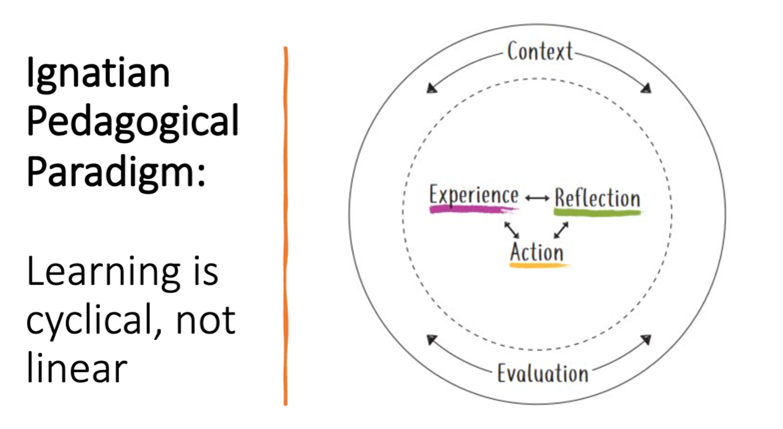
Ignatian Pedagogical Paradigm
The Ignatian Pedagogical Paradigm (IPP) is a teaching and learning framework rooted in the spirituality of St. Ignatius of Loyola, founder of the Jesuits. It is not just a method of instruction, but a way of forming the whole person intellectually, spiritually, morally and socially.
The Five Elements of the IPP
- Context – Understanding the students’ backgrounds, experiences, culture and needs.
- Experience – Engaging students actively in learning (discussion, reflection, service, real-life application).
- Reflection – Encouraging students to think deeply about what they have learned and what it means for them.
- Action – Inspiring students to respond in meaningful ways, applying learning to their lives and the world.
- Evaluation – Assessing not only academic progress but also personal growth and development.
Relevance to a Jesuit School
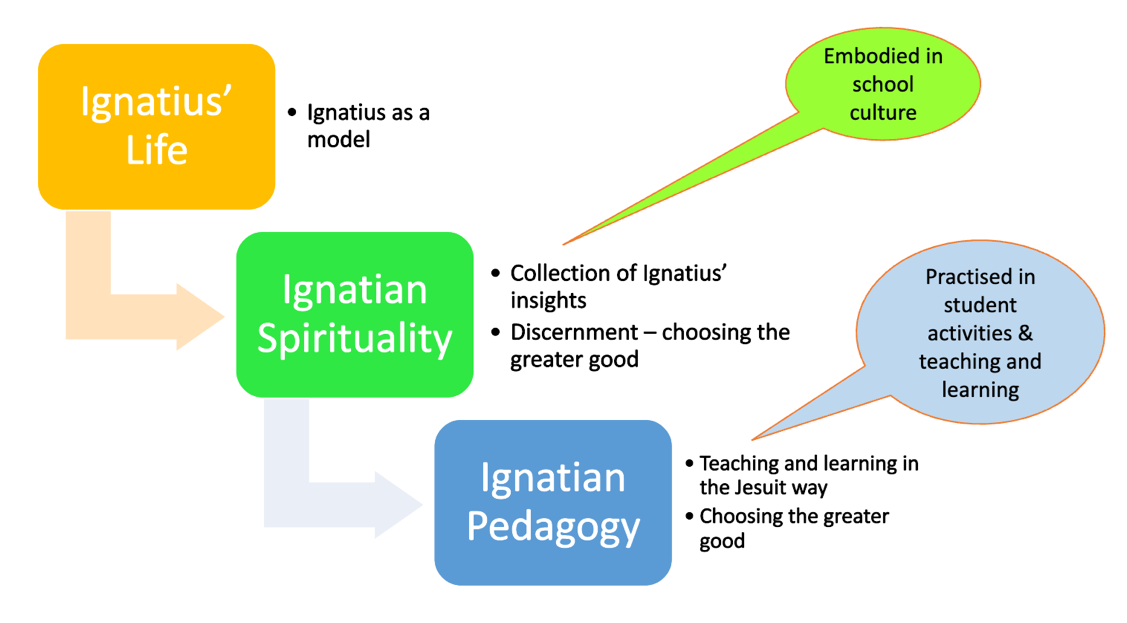
In a Jesuit school, the IPP:
- Shapes the ethos of the school – Education is about forming “men and women for others,” not just achieving exam success.
- Promotes cura personalis (care for the whole person) – Teachers attend to students’ personal, spiritual and emotional development as well as academic growth.
- Encourages justice and service – Learning leads to action, especially in responding to injustice and serving others.
- Supports reflective practice – Students are invited to become thoughtful, discerning individuals who make values-based decisions.
In short, the Ignatian Pedagogical Paradigm ensures that education in a Jesuit school is transformative — aiming not only to inform students, but to form them.